Why Breath Is the Foundation of Yoga and Everyday Well-Being
In a World That Measures Everything, Have We Forgotten to Notice the One Thing That Keeps Us Alive?
🌬️ We All Breathe… But Do We Notice?
We think we're breathing—but are we breathing well?
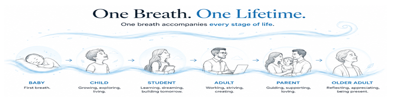
The first thing we do in life is take a breath. The last thing we do is give one back. Somewhere between those two moments, many of us stop paying attention to the one thing that keeps us alive.
Before you read another line, pause for a moment.
Become aware of your breath.Don't change it.
Simply observe where you feel it—your chest, your ribs, or your belly.
I didn’t realize how shallow my breathing had become until one morning I caught myself holding my breath while checking emails. Not stressed, not rushing — just… forgetting to breathe.
You probably remember what you ate for breakfast.
You might know your step count.
You may even know your sleep score.
But can you remember a single breath you took this morning?
Most of us can't—not because breathing isn't important, but because it quietly fades into the background of our lives.
Long before we speak or walk, we take our first breath. From that moment on, it stays with us, asking almost nothing in return except an occasional moment of awareness.
We usually become aware of our breath only when something changes.
Running to catch a bus.
Climbing stairs.
Laughing until our stomach hurts.
Crying.
Feeling anxious.
Or when someone gently reminds us, "Take a deep breath."
The rest of the time, our breath carries us through ordinary days and extraordinary moments alike.
Many people assume that because we're alive, we're breathing well.
Yet very few of us were ever taught to pay attention to our breath.
🌬️ In a World Obsessed With Health…
Watch a sleeping baby — their belly rises and falls like a tiny wave. Soft. Quiet. Effortless. No one teaches a newborn how to breathe. The body simply knows.
Somewhere between learning to walk and learning to succeed, many of us lose that natural rhythm. Not because we chose to — life simply became louder, faster, busier.
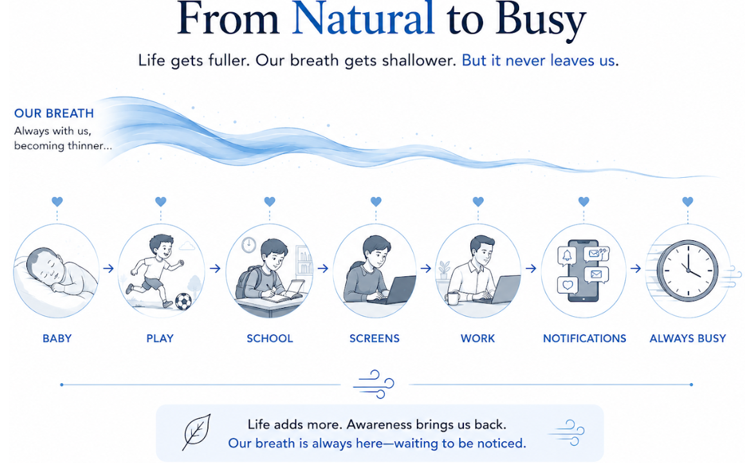
Kids move from school to activities. Adults jump from task to task. Screens, notifications, and deadlines fill the spaces where rest used to live.
I’ve seen children racing with backpacks bigger than their bodies. I’ve seen adults eating lunch while answering emails, barely looking up.
And without realizing it, many people hold their breath while reading, concentrating, or working — a pattern some researchers call “screen apnea” or “email apnea.”
None of us are doing anything wrong. Life simply moves fast — and our breath quietly tries to keep up.
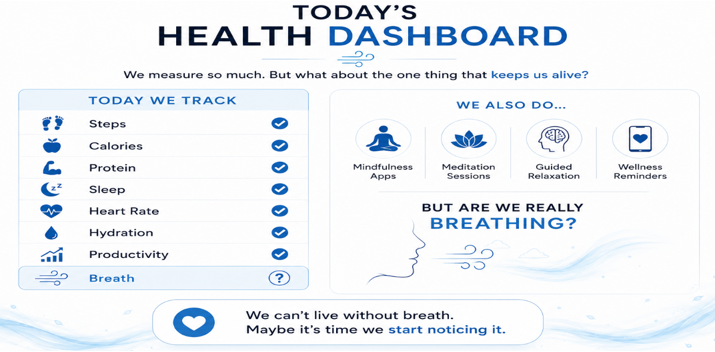
We count our steps.
We track our sleep.
We count protein.
We monitor our heart rate.
We monitor our heart rate.
We think about what we eat.
We follow health influencers and the latest wellness trends.
None of these are wrong.
But in a world that measures every metric, we often forget the one thing that quietly supports them all:
Breathing — the habit that rarely makes the list.
🌬️ Why Breath Matters
Breath is more than simply moving air in and out of the lungs.
Every breath prepares your body to move, focus, recover, and respond to the world around you.
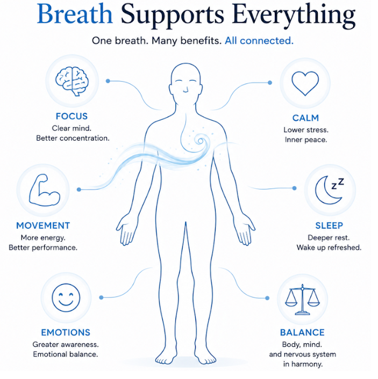
No complicated anatomy — just natural movement.
Breath quietly supports nearly everything we do:
Movement
Focus
Stress
Sleep
Recovery
Emotional well-being
You may notice it during everyday activities,
Walking feels smoother when your breath finds a natural rhythm.
Lifting feels easier when you exhale during the effort.
Stretching becomes more comfortable when you soften into the exhale.
Yoga begins to flow when movement follows the breath.
I first noticed this while carrying groceries. Exhaling during the lift made the effort feel easier.
Later I noticed the same thing in the gym, while gardening, climbing stairs, and practicing yoga.
People count repetitions.
Track calories.
Chase personal records.
Push for "one more."
Yet in all that effort, it's surprisingly easy to forget the simplest part- Breathing.
When breath and movement work together, movement feels smoother, more connected, and often more enjoyable.
Breath doesn't just support movement—it helps you move with greater ease.
🌬️ Breath Lives in Ordinary Moments
Our breath changes with every emotion.
Stress.
Joy.
Fear.
Calm.
Think about the last time you were nervous — your breath probably got tight.
Think about the last time you laughed — your breath opened without effort.
And think about the last time you were frustrated — dealing with a slow computer, trying to get out the door on time. Your breath probably tightened without you noticing.
Breath lives in the smallest moments:
checking emails
standing in line
washing dishes
waiting at a red light
walking into a meeting
cooking dinner
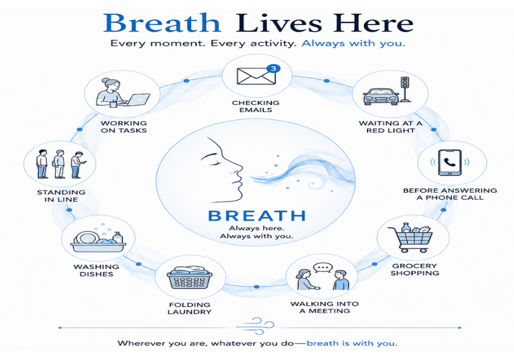
These ordinary moments can become gentle reminders to reconnect with your breath.
🌬️ Have We Forgotten to Teach It?
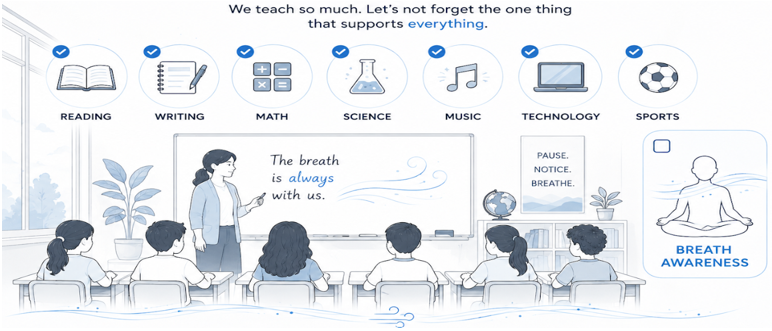
We teach children math, science, reading, writing, drawing, music, technology, and sports.
But do we also teach them how breathing influences:
Focus
Movement
Emotions
Well-being
We’ve taught people how to count grades, calories, steps, repetitions, deadlines, and achievements.
Perhaps it’s time we also teach them how to notice their breath.
Imagine a classroom with every subject checked off — except “Breath Awareness.”
What would change if children learned how to breathe well before they learned how to succeed?
🌬️ Pause. Notice. Breathe.
Take a moment to check in.
Is your jaw relaxed?
Are your shoulders soft?
Are you breathing through your nose?
Is your breath quiet?
You don't need to change anything. Just pause.
Simply becoming aware of your breath is a small act of kindness toward yourself.
No forcing.
No technique.
Just awareness.
If you've been building a daily rhythm, your breath can become part of it. Not another task to complete.
Just a quiet pause woven naturally into your day.
A simple rhythm might look like this:
🌅 Morning- Take one slow breath before getting out of bed.
☀️ Midday- Pause while walking or standing and become aware of your breathing.
🌙 Evening- Finish your day with one slow exhale before going to sleep.
Three quiet moments.
No counting.
No pressure.
Just awareness.
🌬️ One Breath at a Time
Every day we try to improve our health through food, movement, sleep, routines, and habits. Yet the one thing supporting them all is often the one we think about the least.
Breathing isn't another wellness trend. It's the quiet rhythm that has been with you since the day you were born.
I've started paying attention to my breath in ordinary moments—waiting at a red light, standing in line, or washing dishes. I don't try to change it. I simply pause and become aware of it.
Somehow, those tiny pauses create small pockets of calm throughout the day.
Sometimes the smallest pause can change the rest of your day.
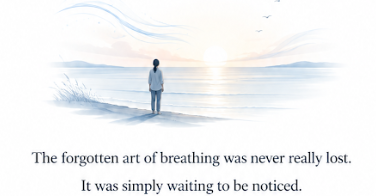
Maybe today won't change.
But one quiet breath might change your moment. And sometimes, that's enough.
Perhaps your next breath is the perfect place to begin.
🌸 Continue Your Journey: Becoming aware of your breath is the first step. The next is learning how to work with it intentionally.
In yoga, these practices are known as Pranayama—simple breathing techniques that can support relaxation, focus, energy, sleep, and everyday well-being.
🌸Next Pathway: Breathing with Intention. Simple Yogic Breathing Practices for Everyday Life