

In Ayurveda, health is not merely the absence of physical disease. It is a state in which Śarīra (body), Indriya (senses), Manas (mind) and Ātman (self) function in harmony. Among these, Manas occupies a unique position because it connects sensory perception, thought, emotion, intention and behaviour.
The Three Guṇas of Manas
- Sattva
- Rajas
- Tamas
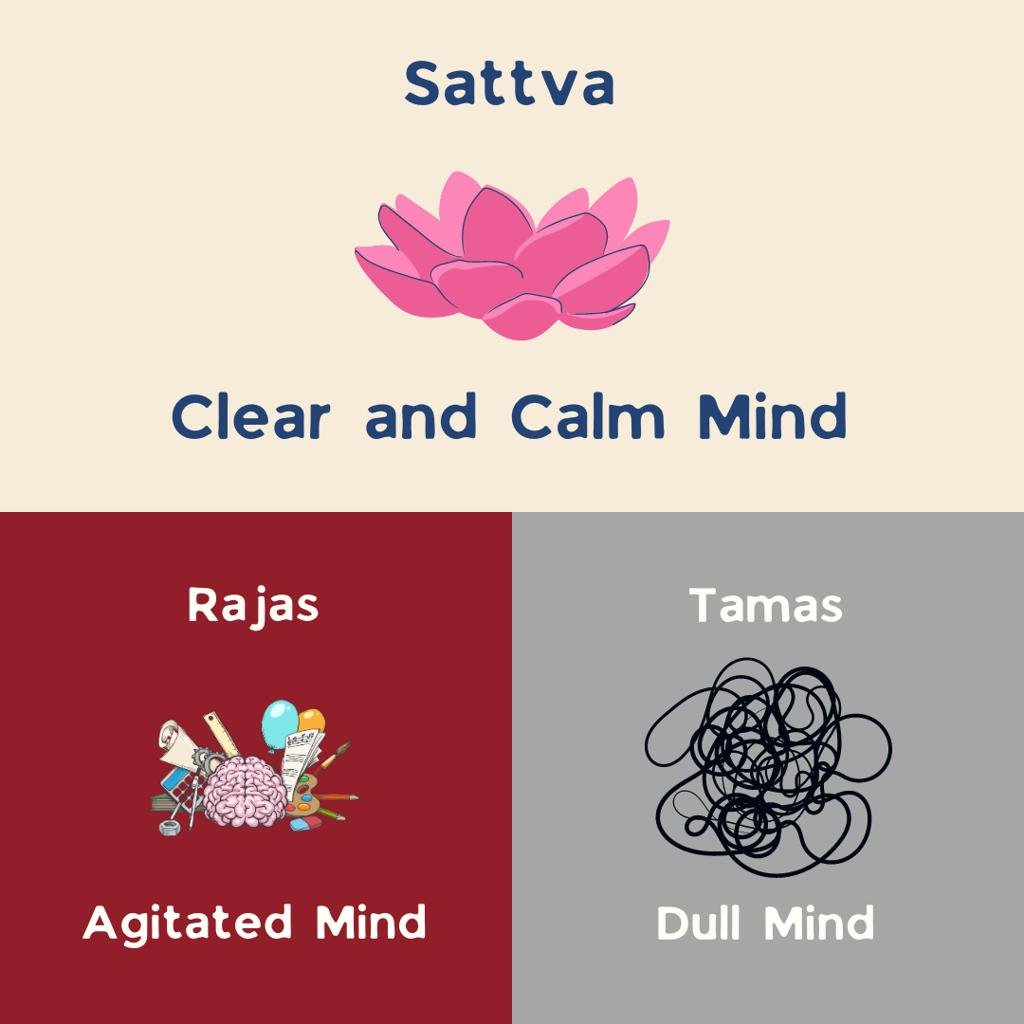
These three qualities help explain different patterns of mental functioning.
1. Sattva – The Quality of Clarity
सत्त्वम्
Sattva is associated with clarity, knowledge, awareness, purity and balance.When Sattva is prominent, an individual may demonstrate qualities such as:
- Clear understanding
- Patience
- Self-control
- Compassion
- Discrimination between beneficial and harmful actions
- Ability to remain composed
- Interest in knowledge
- Emotional stability

Sattva is traditionally regarded as the desirable mental quality because it supports clarity and appropriate understanding. Classical Ayurvedic discussions associate Sattva with enlightenment and knowledge.
“Sattva represents clarity, awareness, balance and the capacity for appropriate discrimination.”
2. Rajas – The Quality of Activity
रजस्

Rajas is associated with movement, stimulation, activity, passion and initiation.Rajas is not simply “bad.” Activity is essential for life. Without movement, motivation and effort, a person cannot accomplish goals.
However, excessive or uncontrolled Rajas may manifest as:
- Restlessness
- Excessive desire
- Impatience
- Irritability
- Overactivity
- Strong attachment to outcomes
- Difficulty remaining mentally quiet

“Rajas represents movement and activation. Balanced activity supports purposeful action; excessive stimulation may disturb mental equilibrium.”
3. Tamas – The Quality of Inertia
तमस्
Tamas is associated with heaviness, inertia, darkness, obstruction and reduced activity.

It is important not to interpret Tamas as something that must simply be eliminated. Rest, sleep and periods of reduced activity have physiological importance.
The problem arises when excessive Tamas becomes associated with persistent:
- Lethargy
- Lack of motivation
- Confusion
- Indifference
- Inertia
- Poor awareness
- Excessive attachment to inactivity
Classical sources describe Tamas in terms of darkness, dullness and inactivity.
“Tamas is associated with inertia and obscuration; in excess, it may hinder clarity and purposeful activity.”

Connection between Manas and Sarira
Ayurveda does not create an absolute separation between physical and mental wellbeing.The Śarīra and Manas continuously influence one another.
A disturbed mental state can influence behaviour, sleep, appetite and daily routines. Similarly, disturbances in the body can influence mood, attention and mental functioning.This integrated approach is one reason Ayurveda considers both physical and psychological dimensions when understanding health.
Methods to Maintain Manasika Swasthya
1. Dinacharya – Following a healthy daily routine.
2. Sadvritta – Practising wholesome conduct.
3. Dhyana – Meditation.
4. Pranayama – Regulation of breathing.
5. Indriya Nigraha – Regulation of sensory activities.
6. Nidra – Maintaining adequate sleep.
7. Sattvika Ahara – Wholesome dietary practices.
Sattvavajaya Chikitsa
Sattvavajaya is an important Ayurvedic approach to mental health. It involves strengthening mental control and withdrawing the mind from undesirable objects and influences.
In practical terms, this Ayurvedic principle highlights:
Awareness → Regulation → Appropriate response
Rather than allowing every sensory stimulus, thought or impulse to automatically determine behaviour, the individual develops the capacity to observe and regulate their response.
Conclusion
From the Ayurvedic perspective, mental wellbeing is therefore not merely about suppressing thoughts or avoiding activity. It is about cultivating clarity, appropriate action, self-control, healthy routines and harmonious living.
A healthy mind is not a mind without activity—it is a mind capable of choosing how to respond