

An Ayurvedic look at traditional ghee, digestion and cooking
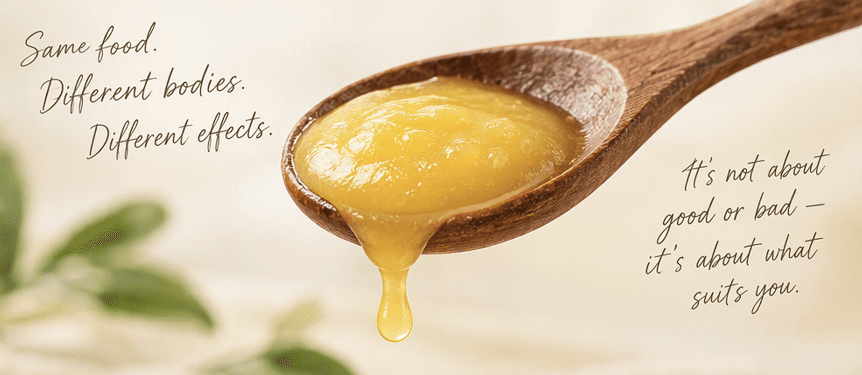
Ghee has been part of Indian kitchens for generations - a spoon in dal, a drizzle on rice, a little in khichdi or vegetables. Ayurveda values it, but that doesn’t mean everyone should eat more.
Why Digestion Matters in Ayurveda
Ayurveda places great importance on digestion. It describes digestion and metabolism through the concept of Agni, often translated as "digestive fire."
When Agni is balanced:
- Food is digested comfortably
- Nutrients are absorbed efficiently
- Appetite feels appropriate
- Energy remains steady
- Waste is eliminated properly
When Agni becomes weak:
- Heaviness may occur
- Bloating may occur
- Appetite may decrease
- Digestion may feel sluggish
Because ghee is a rich, concentrated fat, Ayurveda traditionally considers it most suitable when digestion is functioning well. This is why discussions about ghee in Ayurveda are often linked to digestion rather than the food alone.
Ayurveda considers constitution, digestion, preparation and quantity. Modern nutrition considers fat quality and the overall diet. The useful question is not simply whether ghee is “good” or “bad,” but how it fits into your food and your needs.

What Makes Ghee Different?
Ghee is made by heating butter and separating most of the water and milk solids from the fat.

| Butter | Ghee | |
|---|---|---|
| Water | Contains more | Very little |
| Milk solids | Present | Mostly removed |
| Flavor | Creamy | Rich, nutty |
| Higher-temperature cooking | Milk solids can burn | Generally better suited |
Because ghee is concentrated fat, a small amount goes a long way.
Nutritional Snapshot
Approximate values per 1 teaspoon (5 g) of ghee:
| Nutrient | Approximate amount |
|---|---|
| Calories | ~45 |
| Total fat | ~5 g |
| Saturated fat | ~3 g |
| Protein | Not established |
| Carbohydrates | 0 g |
Ghee is primarily a source of fat and may contain small amounts of naturally occurring fat-soluble vitamins. Exact nutrient levels vary depending on the source and production method.
Traditional Cultured Ghee vs. Cream-Based Ghee
Traditional cultured method follows this path:

The milk is cultured into curd, the curd is churned to obtain butter, and the butter is clarified. This preparation has particular importance in Ayurvedic tradition; cream-based methods are also used.
| Cultured / curd-derived | Cream-based | Commercial | |
|---|---|---|---|
| Fermented first? | Yes | No | Depends on process |
| Ayurvedic significance | Particularly valued | - | - |
| Flavor | Often deeper | Rich | Usually consistent |
| Automatically healthier? | Easy to digest | Not established | Not established |
Culturing and processing can influence flavor and composition.
What Does Ayurveda Say?
Ayurveda describes ghee (ghrita) through traditional qualities:

| Quality | Meaning | Traditional dosha connection |
|---|---|---|
| Snigdha | Unctuous, nourishing | Generally supportive for Vata |
| Guru | Heavy | Excess may aggravate Kapha |
| Shita | Cooling | Traditionally associated with Pitta |
| Madhura | Sweet in taste | Nourishing; excess may increase Kapha |
For centuries, Ayurveda has valued ghee as a traditional kitchen staple.
Classical texts describe ghee as nourishing, unctuous, and supportive when used appropriately. It has historically been used in everyday cooking as well as certain Ayurvedic preparations.
Ayurveda emphasizes individual needs, digestive capacity, overall diet, and moderation.
These are traditional Ayurvedic descriptions, not guarantees of a medical effect. “Cooling” refers to an Ayurvedic quality, not the temperature of the pan or a proven reduction in body temperature.
Dosha patterns are a traditional lens, not a diagnosis. Dryness, acidity, low appetite or heaviness can have many causes; persistent or concerning symptoms deserve appropriate medical advice.

Does Ghee Suit You?
Your constitution is one consideration; your current appetite, digestion, cholesterol status and overall diet matter too.
A simple Ayurvedic way to think about it: ghee may be considered when dryness or a feeling of depletion is prominent (Vata); it is traditionally described as cooling in the Pitta framework; and smaller amounts may be preferred when heaviness, sluggishness or low appetite is prominent (Kapha). These are general traditional patterns, not a prescription based on your dosha alone.
| If you notice… | Consider… | Why |
|---|---|---|
| Comfortable and satisfied | Keep the amount modest | Suggests you tolerate it well |
| Repeated heaviness or sluggishness | Use less or less often | The meal may be too rich |
| Low appetite or recurring digestive discomfort | Reduce or pause and assess | Your current tolerance may be lower |
| Elevated LDL cholesterol | Review your overall intake with a clinician or dietitian | Ghee is high in saturated fat |
| Your diet is already rich in saturated fat | Replace some ghee with an unsaturated oil | Can improve the overall fat balance |

For many people, using 1-2 teaspoons as a cooking or finishing fat is a reasonable starting point if it fits comfortably within their overall dietary pattern.
Any suggested serving is a personal starting point, not a universal prescription. If you have gallbladder or other medical concerns that affect fat digestion, ask your healthcare professional for advice.
If you have a milk allergy, do not assume ghee is safe: although properly clarified ghee contains very little milk protein, traces may remain. Ask your allergist or healthcare professional before using it.
People with lactose intolerance often tolerate properly prepared ghee because most lactose-containing milk solids are removed during clarification. However, tolerance varies from person to person, so individual experience should guide use.
Ghee and Cooking Heat
Ghee is relatively heat-stable because most water and milk solids have been removed. But heat stability does not automatically make a fat the healthiest choice: the type of fat and your overall dietary pattern matter.
| Fat | General cooking note | What to know |
|---|---|---|
| Ghee | Useful for sautéing, roasting and higher-temperature cooking | High in saturated fat |
| Avocado oil | Often suitable for higher-heat cooking | Mostly monounsaturated fat |
| Olive oil | Good everyday option for many cooking methods | Mostly monounsaturated fat |
| Coconut oil | Can tolerate heat | Very high in saturated fat |
| Sesame oil | Used in traditional cooking | Traditionally described as warming in Ayurveda |
For deep-frying, keep the temperature controlled, avoid smoking the fat, and do not repeatedly reuse it. Even heat-tolerant fats can deteriorate with prolonged or repeated heating.
Common Myths About Ghee
Myth: More ghee always improves digestion.
Reality: Ayurveda emphasizes appropriate use according to the individual and their digestive capacity, not unlimited intake.
Myth: Traditional foods can be eaten without limit.
Reality: Ghee remains a concentrated fat, and moderation still matters.
Myth: Heat stability automatically means a fat is the healthiest choice.
Reality: Cooking stability is only one factor. The overall dietary pattern and type of fat also matter.
How to Use Ghee Wisely
Ghee can add flavor to dal and rice, khichdi, cooked vegetables and grains, or be used for sautéing and finishing a dish.
Think “replace, not always add.”
Traditional Ways People Use Ghee
- Stirred into warm dal
- Drizzled over rice
- Added to khichdi
- Mixed with cooked vegetables
- Used for sautéing
- Used as a finishing touch after cooking
These traditional uses allow a small amount of ghee to add flavor and richness without making a meal excessively heavy.
If a meal already contains oil or other rich ingredients, extra ghee may not be necessary. Treat it as a cooking fat, not a supplement you must add to every meal.
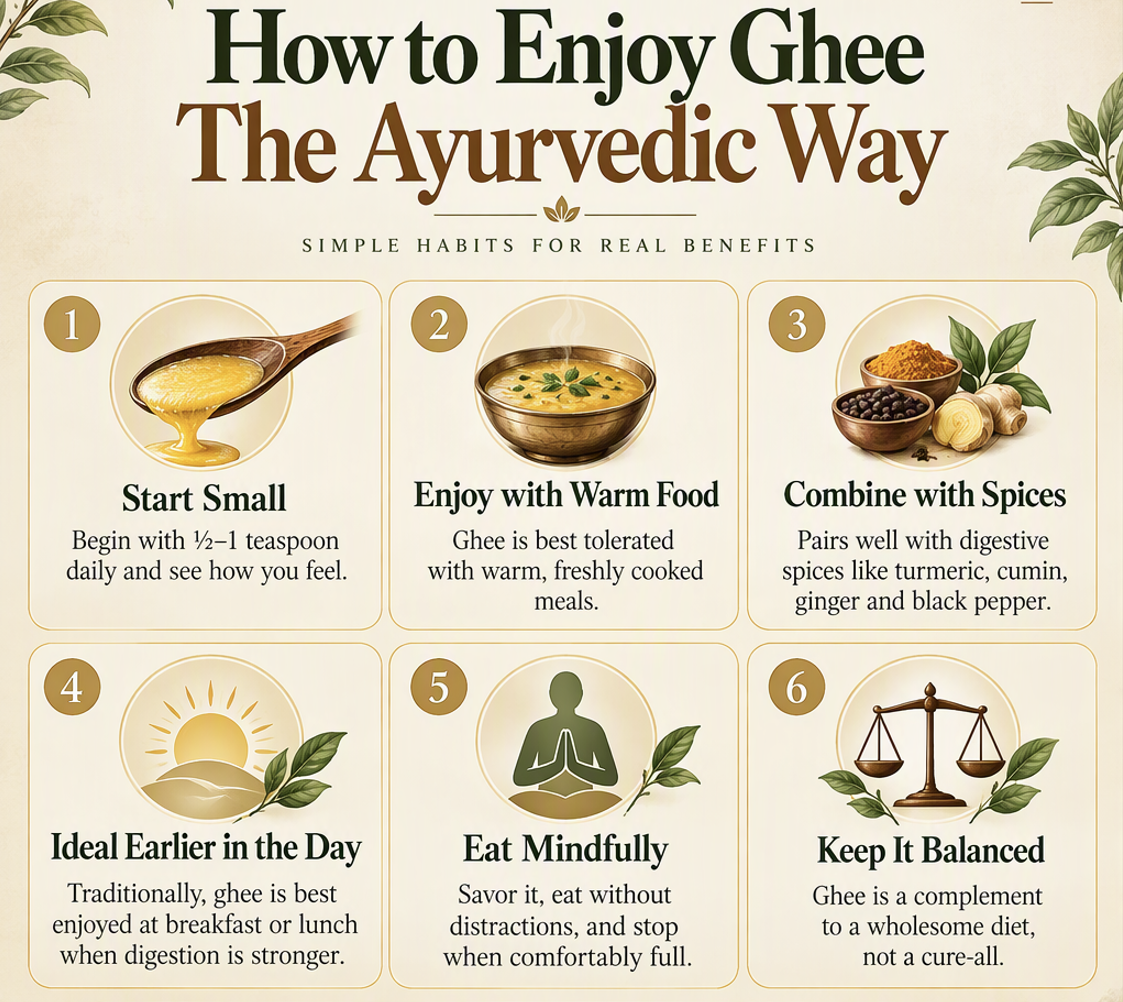
A little can be nourishing. More isn’t automatically better. Like many traditional foods, the value of ghee depends on how much is used, how it is prepared, and how well it fits the individual.
Enjoy ghee when it suits you, and let your digestion and overall diet help guide how much you use.
Quick Takeaways
- Ghee is a concentrated cooking fat.
- Digestion is an important consideration in Ayurveda.
- Traditional preparation methods may influence flavor and composition.
- Ghee can fit into a healthy diet, but moderation still matters.
- The best amount depends on the individual.