Why Today’s Overcrowded Yoga Landscape Leaves People Confused — and How to Find Your Way Back to What Matters
Yoga used to be simple — a mat, a teacher, a quiet room, and a chance to breathe.
Today, it feels like walking into a maze.
There are hundreds of styles, endless labels, heated versions, fusion formats, branded sequences, spiritual paths, athletic paths, therapeutic paths — and every studio seems to invent a new name every year.
Most people look at a class schedule and think:
“What even is all this?
Which one is right for me?”
If you’ve ever felt confused or overwhelmed by modern yoga, you’re not alone. The industry grew faster than people’s ability to understand it, and somewhere along the way, yoga stopped feeling like a path and started feeling like a puzzle.
Here’s the good news:
Yoga isn’t complicated — it’s just crowded.
Once you clear the noise, you can find your way back to what actually matters.
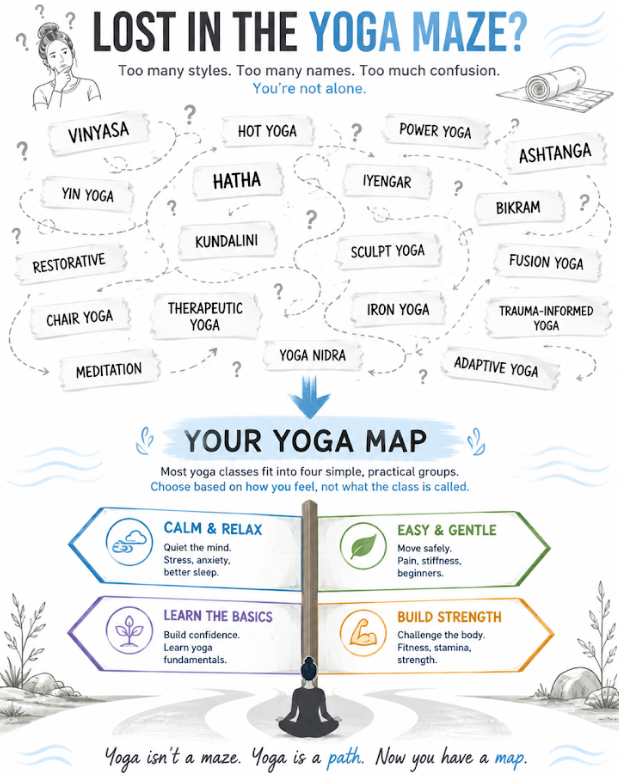
Let’s simplify the entire yoga world into something normal people can finally understand.
🌪️ Why People Feel Lost in Today’s Yoga World
1. Too many names, not enough clarity
Vinyasa, Yin, Ashtanga, Iron Yoga, Hot Yoga, Hatha, Iyengar, Kundalini…
Most people don’t know what any of these mean — and they shouldn’t have to.
2. Fitness culture blurred the lines
Yoga became a workout, a sweat session, a flexibility contest, a performance.
This pushed people away from yoga’s original purpose: feeling better in your body and mind.
3. Marketing made yoga sound complicated
Studios created new names to stand out.
Brands invented new formats.
Influencers added their own twists.
The result? Confusion.
🌱 The Truth: Yoga Isn’t Complicated — It’s Just Overcrowded
Underneath all the noise, yoga still falls into four simple groups anyone can understand.
These groups help people choose yoga based on:
how they feel
what their body needs
what their mind needs
their energy level
their pain level
their flexibility
their comfort with heat
their comfort with movement
Not based on confusing studio labels.
This is your normal‑people yoga map — the one that finally makes sense.
🧘♀️ THE FOUR GROUPS THAT MAKE YOGA SIMPLE AGAIN
Below are your full master tables, updated, corrected, and polished.
🌬️ GROUP 1 — Calm & Relax
Stress relief, grounding, nervous‑system soothing

🌱 GROUP 2 — Easy & Gentle
Beginner‑friendly, stiff‑body friendly, pain‑friendly movement

🌿 GROUP 3 — Learn the Basics
Foundational poses, alignment, confidence building

💪 GROUP 4 — Build Strength
Heat, strength, stamina, discipline, sweat

🌟 The Perfect Teacher Matters Too
Styles matter. Tables help. Categories help.
But the teacher shapes your experience more than the style ever will.
A great teacher:
makes you feel safe
explains things clearly
adjusts poses gently
respects your limits
inspires you
helps you grow
becomes someone you look toward
Yoga is not just a class. It’s a relationship.
And the right teacher helps you find your way back to yourself.
🌈 Finding Your Way Out of the Yoga Maze
You don’t need to memorize every yoga style.
You don’t need to decode studio schedules.
You don’t need to be flexible, spiritual, athletic, or perfect.
You just need:
the right group
the right teacher
the right pace
the right support
the right intention
Yoga becomes simple again when you choose based on how you feel, not what the class is called.
Your four groups — Calm & Relax, Easy & Gentle, Learn the Basics, Build Strength — bring people back to clarity, confidence, and comfort.
Yoga isn’t a maze. Yoga is a path.
And now you have the map.
🌸Continue Your Journey: Once you understand the four yoga groups, the next question is:, the next question is how do I know which one is right for me?
This is where Ayurveda steps in.
🌸Next Pathway: How Yoga and Ayurveda works together?